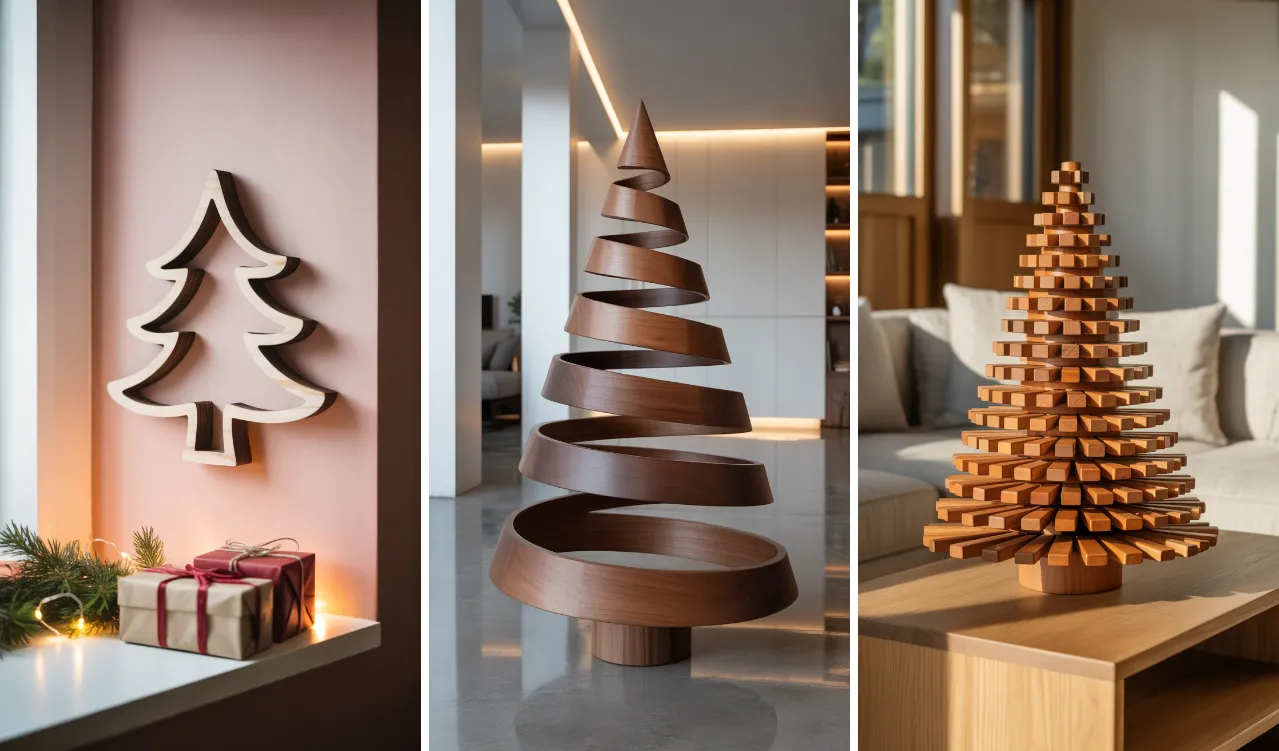
Looking for a fresh, eco-friendly twist on the classic pine Christmas tree? Handmade wooden tree alternatives bring charm, sustainability, and creativity into your holiday décor. These ideas use wood scraps, pallet planks, dowels, and branches instead of cutting a live tree. They offer unique shapes, textures, and styles while giving you a project that can be reused year after year. Let’s explore 15 different wooden tree alternatives you can make or buy, each with its own vibe and possibilities.
Table of Contents
- 1. Pallet-Wood Triangle Tree
- 2. Floating Wall Slat Tree
- 3. Branch-Stack Tree
- 4. Spiral Dowel Tree
- 5. Flat Wall Cut-out Tree
- 6. Reclaimed Wood Shim Tree
- 7. Ladder-Style Leaning Tree
- 8. Stackable Block Tree
- 9. Wooden Round-Slice Tree
- 10. Branch Tiered Shelf Tree
- 11. Driftwood Wall Tree
- 12. Wooden Slat “Book” Tree
- 13. Reclaimed Door Panel Tree
- 14. Spiral Board Tree
- 15. Wooden Starburst Tree
- Conclusion
1. Pallet-Wood Triangle Tree
This idea uses reclaimed pallet planks cut to different lengths, stacked or arranged in a triangular tree shape. The wood’s rough texture gives a rustic feel, and you can leave it natural or paint it in festive hues. One paragraph might talk about selecting sturdy pallets, cleaning and sanding the boards, and arranging them from longest to shortest to form the triangle. Then decorative lights or ornaments can be clipped or hung directly onto the planks, giving a rustic, handcrafted look.
The flat back can sit against a wall, and the footprint is small compared to a full pine tree. It’s also environmentally smart: you’re reusing materials instead of buying a cut tree. You could personalize it by staining the wood, adding a star on top, or even mounting the whole piece on a vertical board to hang. This makes a striking holiday statement with minimal mess.
2. Floating Wall Slat Tree
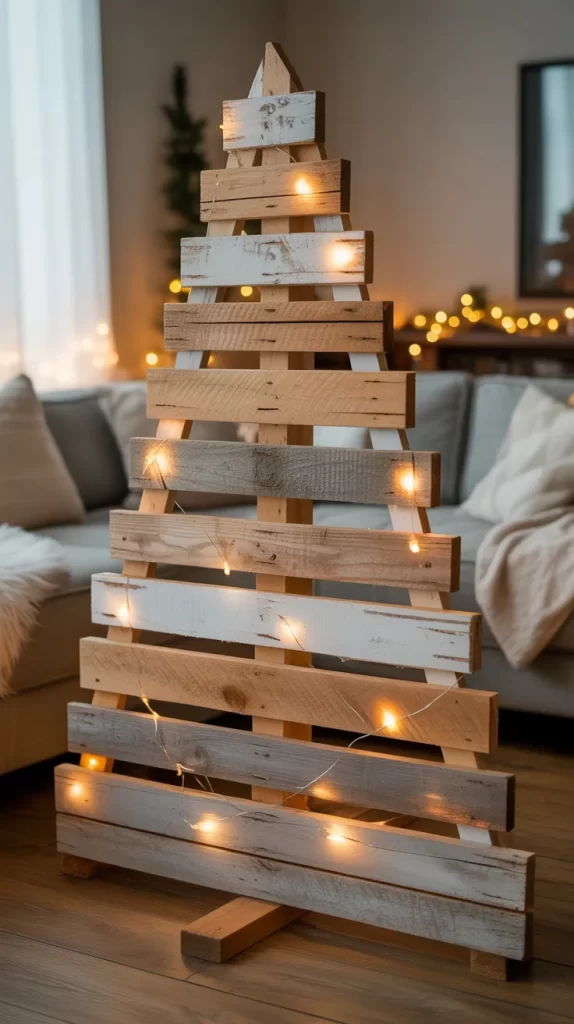
In this variation, you use wooden slats or dowels fixed horizontally on a wall, decreasing in length as you go up, creating a tree silhouette. The wood can be light-colored or painted white, giving a minimalist aesthetic. The first paragraph describes how to measure and mark the wall, attach slats securely, and perhaps paint or finish the wood to maintain a clean look. Because it’s wall-mounted, it saves floor space and gives a modern, graphic take on the tree shape.
Add LED strip lights behind the slats for back-lighting, hang small ornaments with string on the slats, or integrate greenery between the slats for contrast. The floating slat tree works well in apartment living rooms or hallways, as it reduces clutter and stays sleek. You can remove or adapt each year, maybe changing the wood finish or accent colour to match your décor.
3. Branch-Stack Tree
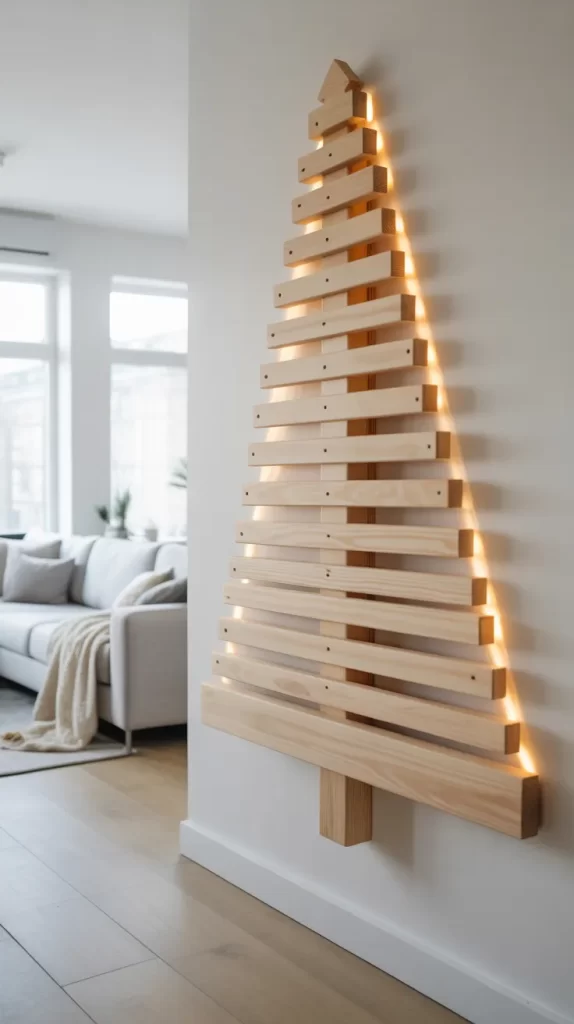
Here, you gather real wood branches (fallen from trees) of varying lengths and stack them horizontally or lean them in a teepee shape to form a natural-wood alternative tree. The first paragraph explains sourcing clean dry branches, trimming them, and arranging them on a base or simply leaning them in a corner. The natural bark and irregular shapes give a raw-nature feeling. You might paint the tips white for a snowy look or leave them as is for a woodland style.
You can string fairy lights around the branches, hang small wooden ornaments or pinecones, and even include bits of moss or twine for texture. It’s perfect for rustic or cabin-style interiors and gives an organic, outdoors-in look. Plus, after Christmas, you could repurpose the branches into woodcraft or firewood (if safe).
4. Spiral Dowel Tree
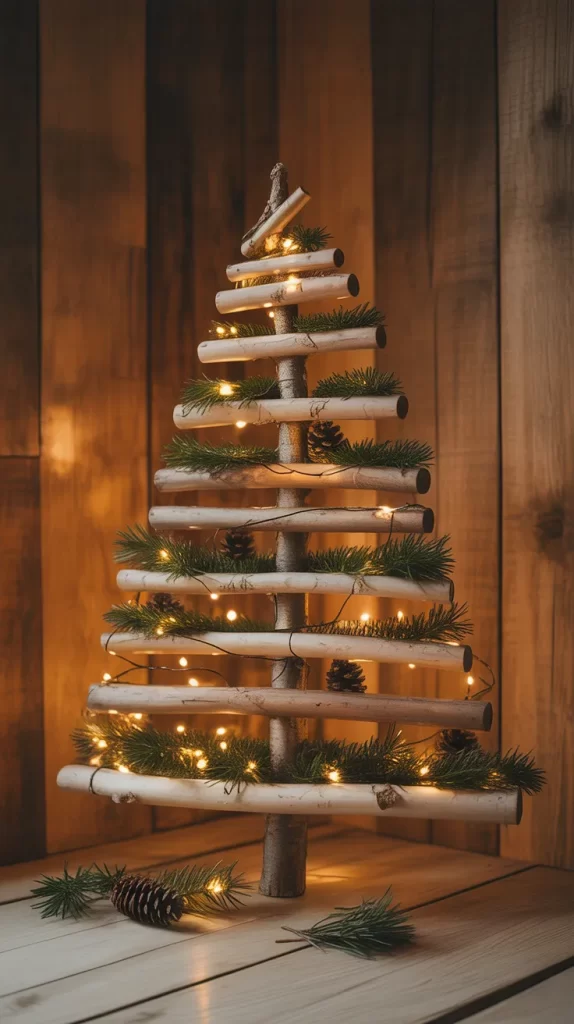
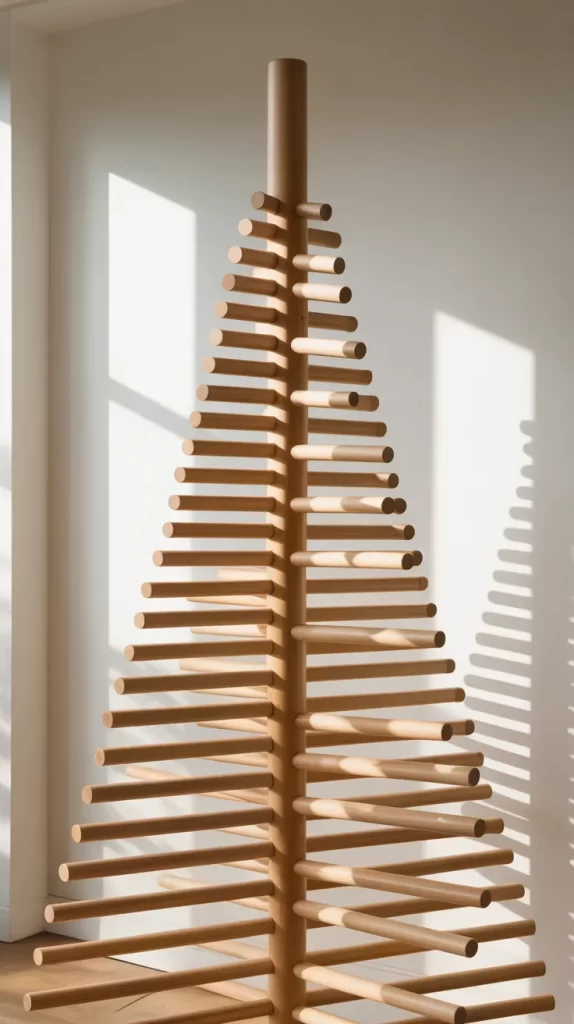
A more geometric craft: take a sturdy vertical wooden dowel as trunk, then insert horizontal dowels at varying angles and lengths to create a spiral or swirling tree form. The first paragraph covers selecting a tall, straight dowel, drilling angled holes, inserting smaller dowels to reflect branches, and securing everything with wood glue or screws. The end result is a sculptural tree silhouette made entirely of wood.
You might leave the wood natural or paint it in metallic tones. You can hang ornaments from each horizontal dowel, or wrap a light string around the spiral. This tree is excellent for minimalist homes or modern décor, where you want holiday presence without the fullness of a pine. It’s also compact and can act as a permanent décor piece.
5. Flat Wall Cut-out Tree
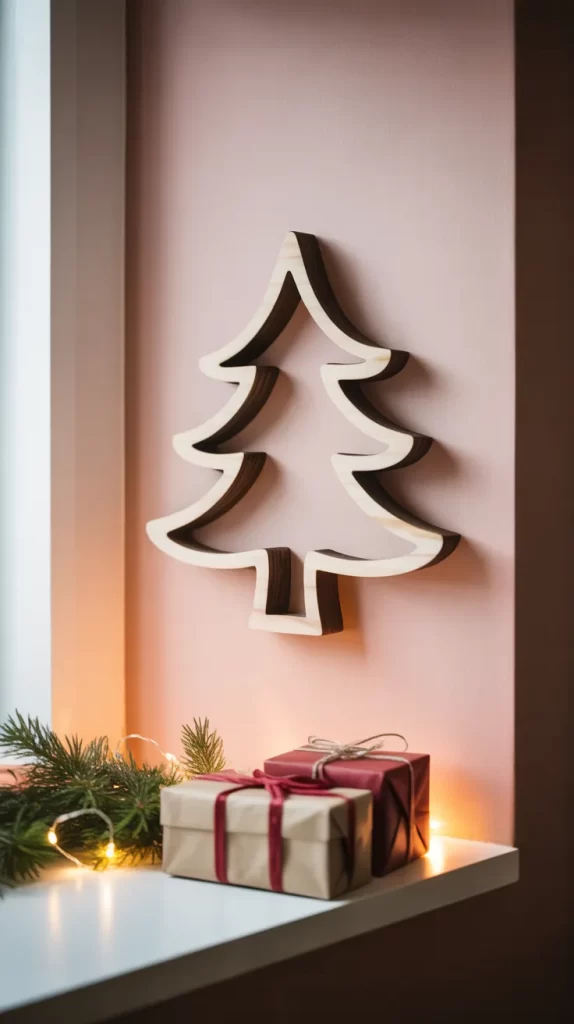
This concept involves cutting a tree outline from a large sheet of plywood or several planks and mounting it flat against a wall like wall art. The first paragraph would describe how to plan the shape, draw the outline, saw it out, sand the edges, and finish the wood (paint, stain, or varnish). Because it’s flat, it fits flush to a wall and doesn’t take up floor space.
you could paint each “branch” line in alternating colours, or affix small hooks for hanging ornaments. Lights can be threaded around the cut-out or behind it for a halo effect. The flat tree is ideal for apartments or spaces where floor clearance is low. It also makes removal and storage simple after the holidays.
6. Reclaimed Wood Shim Tree
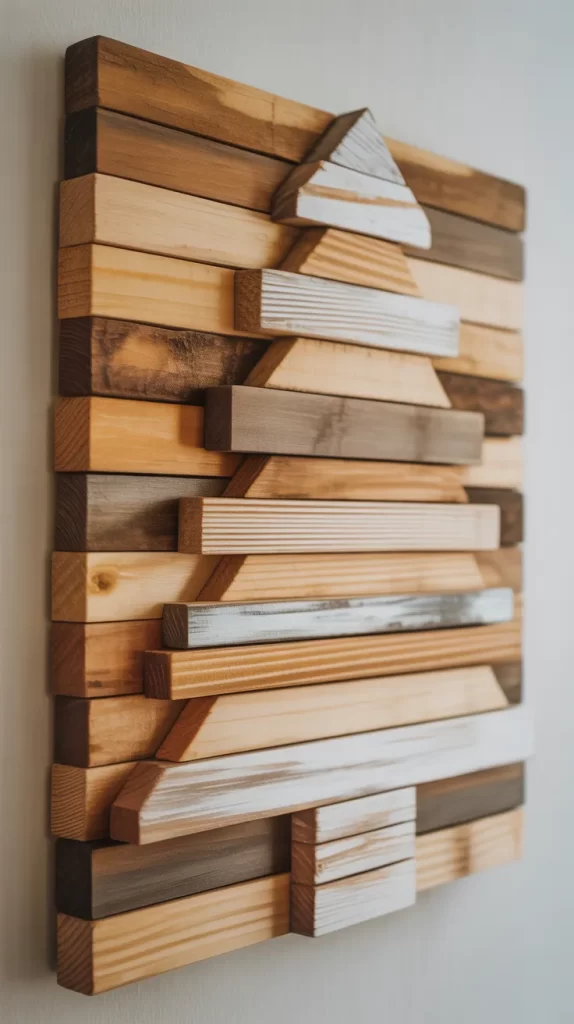
Using many narrow wood chips or “shims” arranged in a tight pattern, you create a full tree shape on a board or wall. The first paragraph describes collecting wood shims or thin off-cuts, gluing them upright or at angles onto a backing board, creating a textured tree surface. The natural variation of wood grains creates visual interest.
You can paint some shims white or gold for contrast, or leave them all natural for a monochrome look. It works as a statement piece in a foyer or hall and makes a great conversation piece—turning scrap wood into statement holiday decor.
7. Ladder-Style Leaning Tree
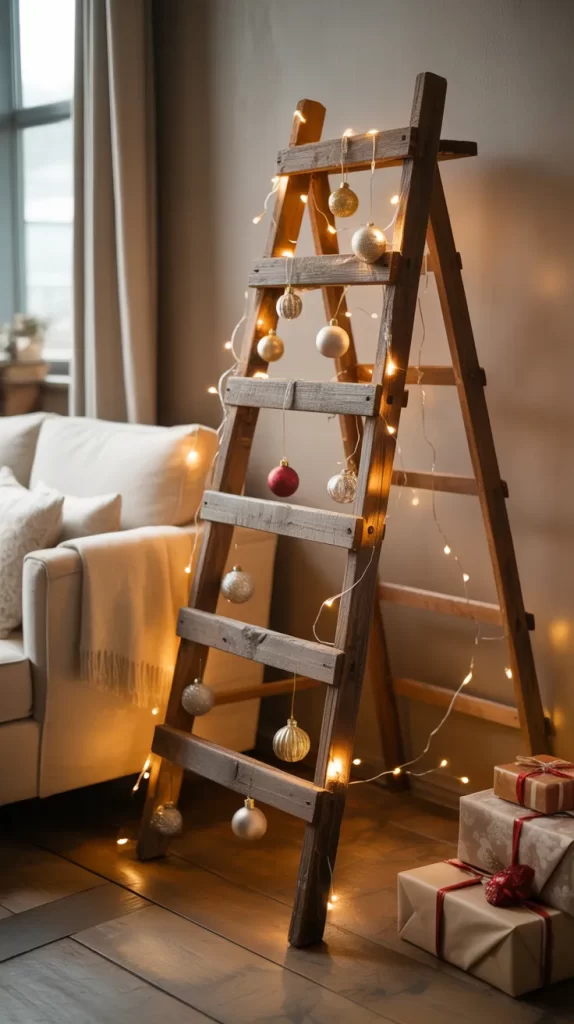
Here, you repurpose an old wooden ladder (or build one) and decorate it as a Christmas tree alternative. The first paragraph covers sourcing or building a sturdy ladder, cleaning, sanding, and positioning it at a lean angle. Each rung becomes a shelf/branch where ornaments and lights can be hung or placed.
drape garlands, wrap lights, place small potted plants or candles on the rungs. The wooden ladder tree adds height and draws the eye upward. Since it leans, it uses vertical wall space and can be placed in corners. After the holidays you can repurpose the ladder for shelving or as décor.
8. Stackable Block Tree
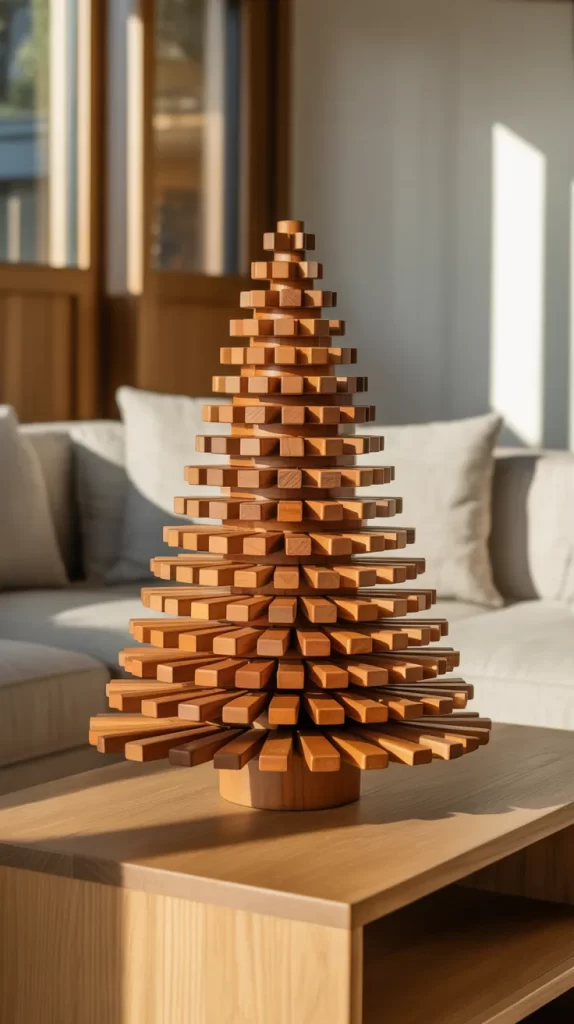
Imagine stacking wooden cubes or blocks of decreasing size to form the shape of a tree. The first paragraph explains how to get or make blocks (either solid wood or hollow), stain or paint them in wood tones, and arrange them largest at the bottom, smallest on top, forming a tiered pyramid. This creates a clean, geometric tree form.
you could pull one block off each year for fun, or use the blocks for other décor later. You can also wrap string lights around or between the blocks, place a star block on top, or create alternating colours. This is great for modern homes or spaces where a low-profile tree is preferred.
9. Wooden Round-Slice Tree
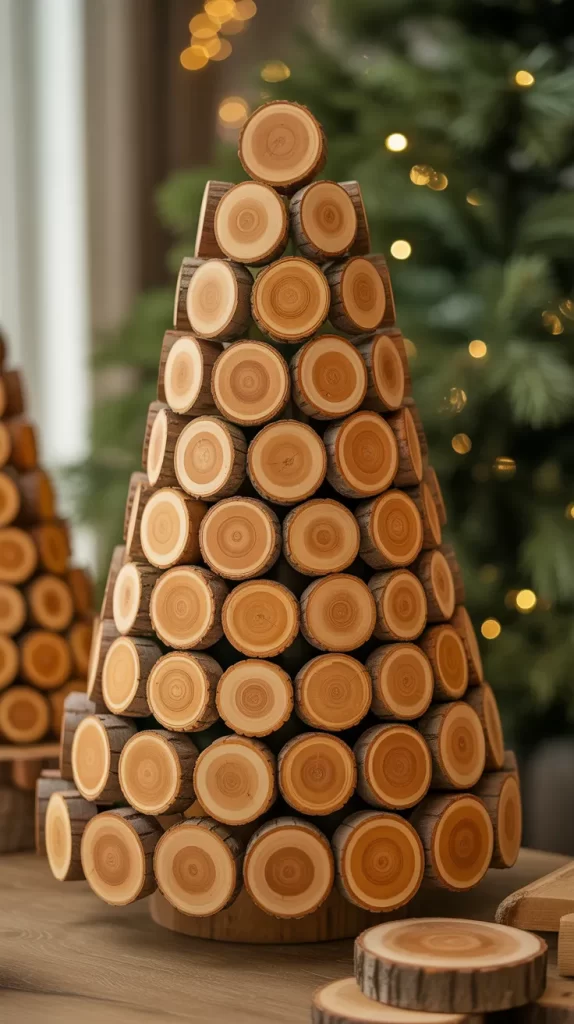
This idea uses round slices of wood (tree trunk cross-cuts) of various diameters stacked or attached to form a tree shape. The first paragraph describes sourcing wood slices, sanding and sealing them, then arranging them either by gluing to a board or stacking them in a frame so the largest are at the bottom and smallest at the top.
You can decorate each slice with a small ornament, use them as surfaces for tealights, or leave them bare for a minimalist look. A tree built this way feels earthy and sculptural, and the wood slices can later be used as coasters or wall art.
10. Branch Tiered Shelf Tree
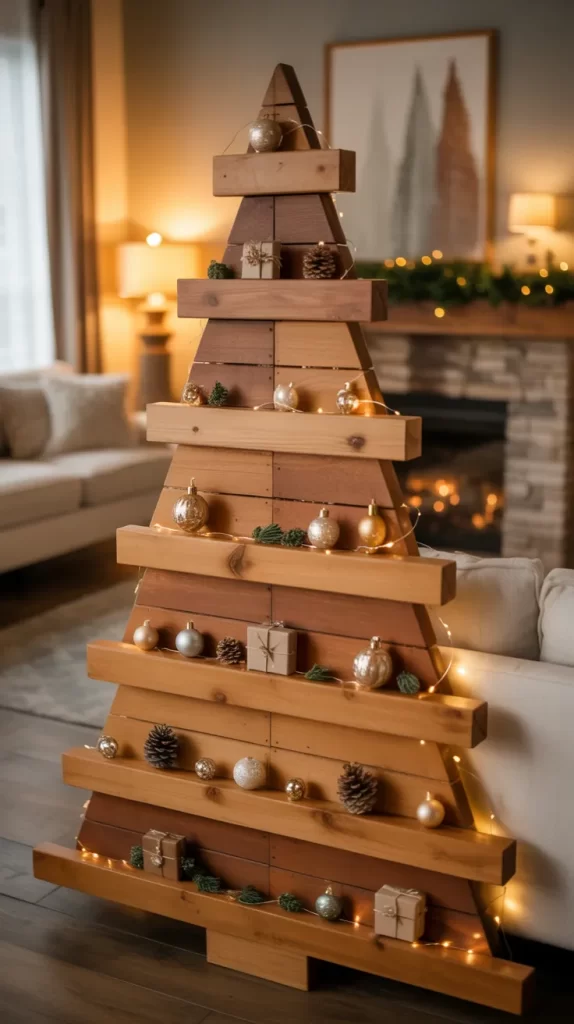
In this version, you build a tiered shelving tree: horizontal wooden planks of decreasing length stacked vertically with space in between, supported by a central spine or by bracketed wall mounts. The first paragraph explains assembling the central support, fixing the planks, and creating the tree silhouette by gradually reducing plank widths or lengths.
each level becomes a shelf where you place decorations, small plants, candles, or ornaments. It functions both as a tree and a display shelf all season long. You could switch it to display books or photos after Christmas. This approach blends functional furniture with festive form, making it versatile and long-lasting.
11. Driftwood Wall Tree
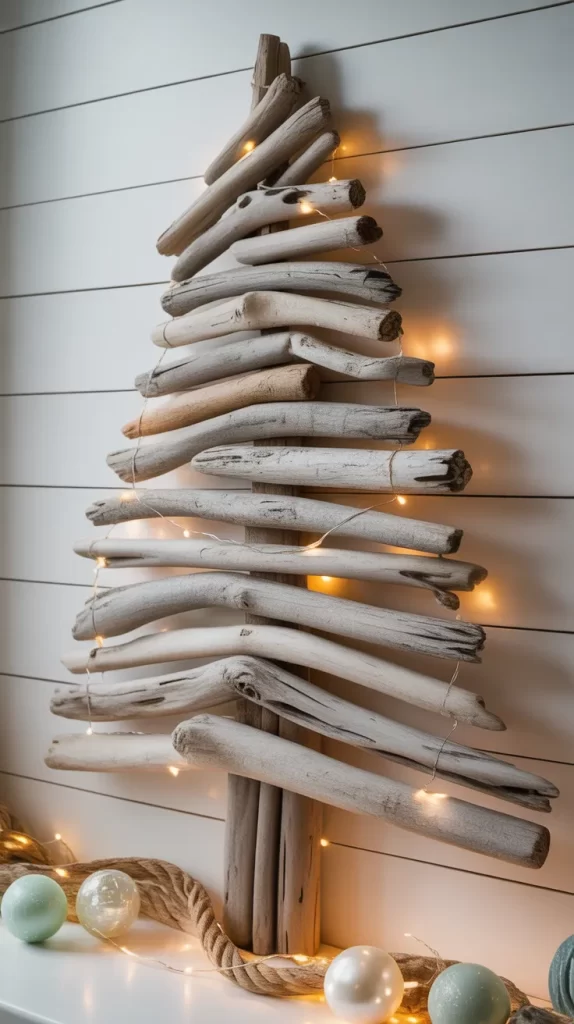
For a coastal or boho look, collect driftwood pieces of varying lengths and assemble them into a tree shape on the wall. The first paragraph describes sourcing cleaned driftwood (or weathered wood), arranging them in a tree outline, and either nailing or gluing them onto a backing board or directly onto the wall.
soft pale wood tones, organic irregular shapes, and a relaxed, beach-inspired holiday feel. You might hang shell ornaments, seashell garlands, or white lights to enhance the driftwood look. After the holidays, it can become art on its own wall.
12. Wooden Slat “Book” Tree
Here, you use wooden slats hinged or linked so they open up like a book and fan out into a tree shape. The first paragraph explains how to join thin wood slats with small hinges or rope, then spread them out to form branching layers, and attach a base to hold them upright. When closed, they can even fold flat for storage.
how this tree is space-saving, clever, and unique. You can stain each slat a different shade for an ombré effect, hang ornaments on the slats, or clamp small lights. This is perfect where you want something compact yet artistic. It also gives you a piece that folds away easily after the holidays.
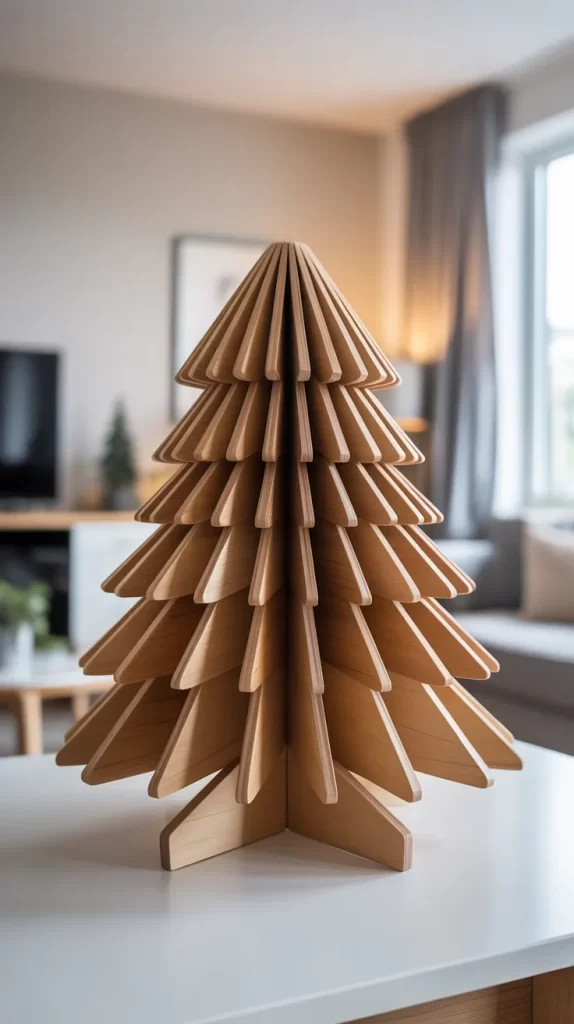
13. Reclaimed Door Panel Tree
This design repurposes an old wooden door or panel: you lean it or mount it vertically, draw or cut a tree outline on it, then decorate the panel as though it’s the tree. The first paragraph covers selecting a solid panel, prepping the surface, painting or leaving natural, and outlining the tree shape. You can attach hooks, lights and ornaments directly to the panel.
The door’s texture and hardware add character. You can lean it against a wall in a foyer or hang it above a mantel. After Christmas, it could remain as decorative paneling or upcycled furniture.
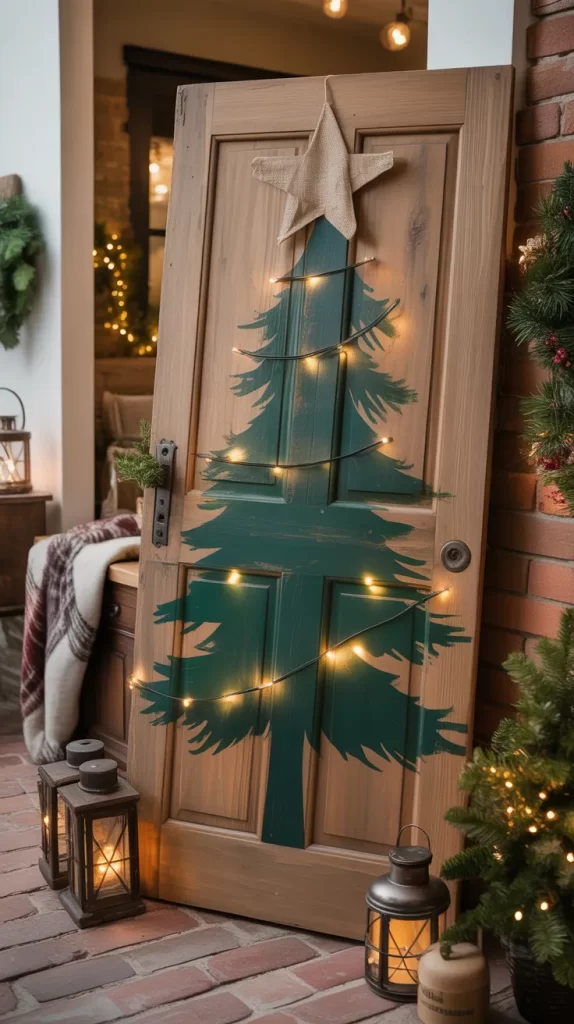
14. Spiral Board Tree
Using a long thin wooden board or sheet, you cut a spiral or helix outline so that when you stand it up the spiral winds downward and out, forming a tree shape. The first paragraph describes choosing the board, drawing the spiral, cutting carefully with a jigsaw, sanding edges, and standing it upright on a base or anchored to the wall.
You might finish it in bold colour or keep it natural. Wrap lights along the spiral or hang ornaments at each twist. The finished piece is less about green branches and more about form and space—ideal for design-forward homes.
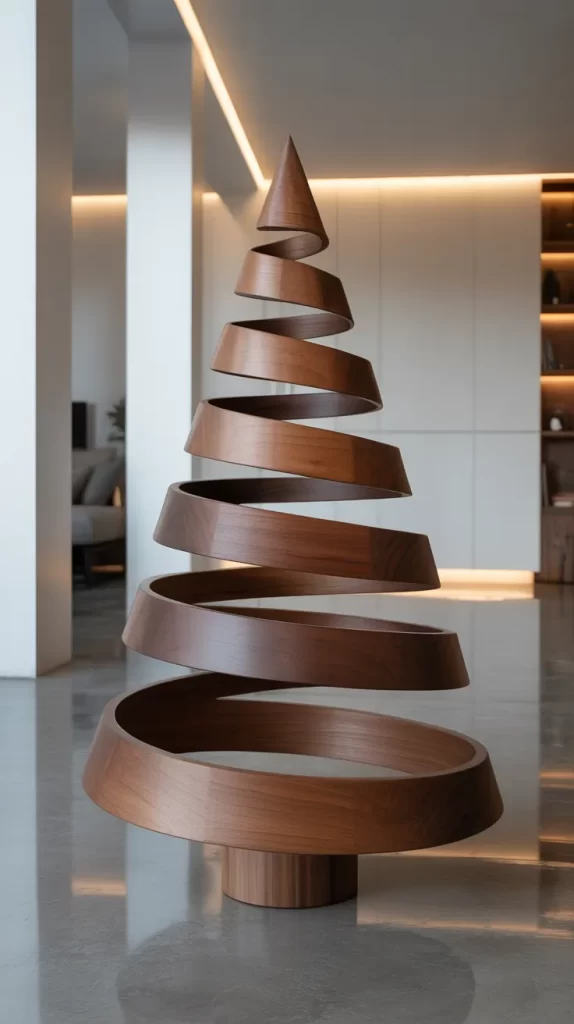
15. Wooden Starburst Tree
This tree uses radial wooden beams or planks radiating from a central point mounted on a wall or ceiling, forming a starburst tree shape. The first paragraph details mounting a central hub or disc, attaching planks outward in decreasing lengths, and finishing the wood surface. The fan-style arms mimic branches reaching outward.
you can hang small ornaments at the ends of each plank, add lights radiating from the center, or paint the tips white for snow effect. This dramatic style adds height and visual energy to a space, and gives you a unique take on tree form rather than a standard pyramid. After the season you might leave it as wall art.
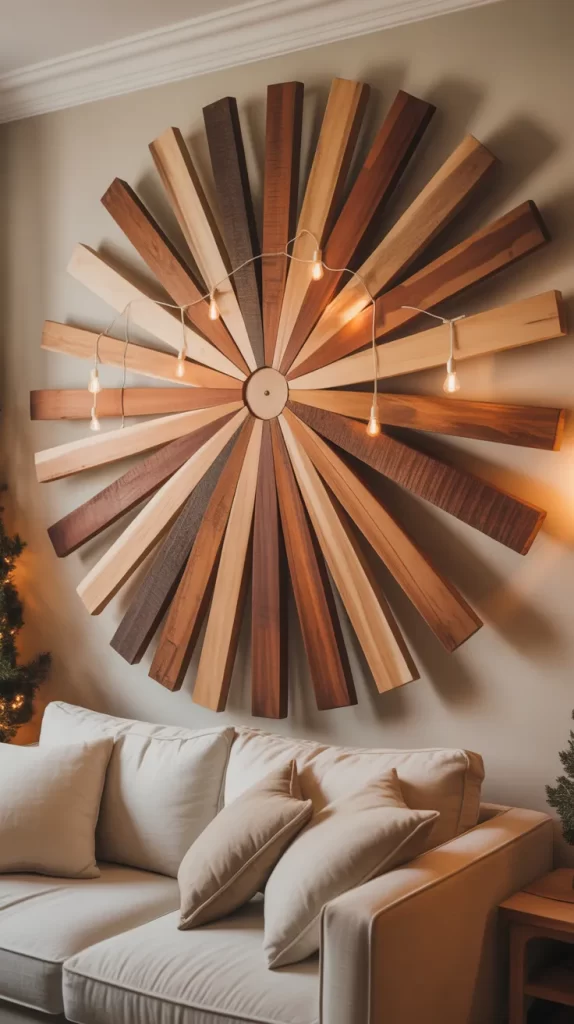
Conclusion
Choosing a wooden tree alternative to a traditional pine tree opens a world of creative, reusable, and often more sustainable holiday décor. Whether you’re drawn to rustic charm, modern minimalism, or artistic sculptural forms, there’s a wooden version for every space and style. These 15 ideas offer you lots of inspiration—and each one gives you freedom to personalise. The best part: many of them can live on past the holidays as seasonal décor or even everyday furniture. Happy crafting and happy holidays!